A vivid, dramatic performance of Das klagende Lied at the Cheltenham Music Festival - 2026 Big Sing

| Type of post: | Review |
| Sub-type: | No sub-type |
| Posted By: | Mike Elcock |
| Status: | Current |
| Date Posted: | Mon, 6 Jul 2026 |
https://seenandheard-international.com/2026/07/a-vivid-dramatic-performance-of-das-klagende-lied-at-the-cheltenham-music-festival/
Cheltenham Music Festival. Brahms, Bruckner, Mahler: Lee Bissett (soprano), Claudia Huckle (contralto), Elgan Llyr Thomas (tenor), Aidan Smith (bass), South Cotswold Big Sing Group, British Sinfonietta / Adrian Partington (conductor). Tewkesbury Abbey, 4.7.2026. (JQ)
Brahms – Academic Festival Overture, Op.80
Bruckner – Te Deum, WAB 45
Mahler – Das klagende Lied
On the second day of the 2026 Cheltenham Music Festival, the main evening concert was given a few miles away in the magnificent medieval Tewkesbury Abbey.
Before discussing the concert, I think I should say a word or two about the South Cotswold Big Sing Group (SCBSG). Formed in 2008, its members are drawn mainly from a number of well-established local choral societies in the area south of Gloucester and north of Bristol. All the participating choirs put on their own programmes as usual throughout each year; the SCBSG exists as an organisation though which they can all cooperate. Crucially, they come together once a year, to rehearse and perform very large-scale works which would be well beyond the resources of even a couple of the constituent choirs combined. Adrian Partington, the Director of Music at Gloucester Cathedral and Artistic Director of the BBC National Chorus of Wales, has been involved with them for several years; under his leadership and with generous sponsorship they have performed such ambitious works as the Te Deum and Grande messe des morts of Berlioz; Holst’s Hymn of Jesus; Mahler’s Eighth Symphony; and the Poulenc Gloria. As an amateur choral singer myself, I think this is a great idea, especially in these cash-constrained times for choral societies. The SCBSG has performed at the Cheltenham Music Festival several times in the past but this was the first opportunity for me to hear them in action. In keeping with their tradition, Partington had chosen a challenging and enterprising programme. Tonight, I would put the size of the choir at between 80 and 90 singers; over twenty choral societies were represented.
Brahms composed his Academic Festival Overture in 1880 as a thank-you tribute to the University of Breslau, which had decided to award him an honorary doctorate in music. It was one of a pair of concert overtures which Brahms wrote around this time; the companion piece is the Tragic Overture, Op.81. The two could scarcely be more different; the latter overture is full of dark drama, whereas in the Academic Festival Overture Brahms is at his most congenial. In the course of the overture Brahms deployed a number of good-hearted traditional student songs, culminating in ‘Gaudeamus igitur’, which is given stately treatment amid a good deal of orchestral counterpoint. On this occasion, we heard something a bit different from the usual in the form of the choral arrangement made by Sir Malcolm Sargent. At a signal from the rostrum, the choir stood to sing the ‘Gaudeamus igitur’ in unison. I must admit, I wasn’t wholly surprised by this; I recall that Partington performed the work at the 2010 Three Choirs Festival and added this choral gesture then. Those who expect authenticity in Brahms performance would doubtless have a fit of the vapours but I think it adds a ‘naughty but nice’ dimension.
Bruckner worked on his setting of the Te Deum between 1881 and 1884; thus, it is contemporaneous with the Sixth and Seventh symphonies. Almost inevitably, especially in a resonant acoustic such as this one, there were some problems of balance; when playing loudly, the orchestra tended to overpower the choir. I don’t really blame the players for this. For one thing, it must be very difficult to adjust to this sort of acoustic on, I presume, just one rehearsal. Also, when Bruckner writes typically sonorous music for the full brass and marks it ff – as happens at several junctures – it just doesn’t work if the music is played mf. Though the orchestra dominated at times I could hear sufficient of the choir’s contribution to tell that they were singing accurately and with commitment. I admired in particular the fact that they were undaunted by the fearsomely high tessitura in several extended passages. Ideally, it would have been good if the SCBSG had had an extra twenty voices, mainly tenors and basses, but even so, they made a good showing. The solo quartet did well. Bruckner gave pride of place to the tenor, who frequently leads the quartet. I thought Elgan Llyr Thomas was terrific. He sang clearly and with ringing tone; I enjoyed his contributions very much. His three colleagues are given less prominent roles by Bruckner but they sang well. Partington conducted the piece with conviction. He energised his choir and orchestra in the many fervent episodes and he also ensured that the dynamic contrasts, always so crucial in Bruckner’s music, were scrupulously observed. Importantly, he kept the music on the move so that the performance always had purpose.
Over the years, I have attended multiple live performances of all the Mahler symphonies and orchestral song cycles. However, just one work has eluded me: Das klagende Lied. This early cantata only received its UK premiere in 1956, and even today it remains a rarity. So, when I saw that the work was to be performed at the Cheltenham Music Festival I was determined to attend.
The history of Das klagende Lied is somewhat complex but it is worth summarising because it is relevant to the version of the score which we heard tonight. Maher finished his cantata in 1880, the same year that Brahms wrote the Academic Festival Overture. He revised the work in 1893 and 1894. As originally conceived, the cantata is in three parts. However, the first part, ‘Waldmärchen’ (Forest Legend) presents some problems, I think. Dramatically, ‘Waldmärchen’ is relevant because it sets the scene for the action in Parts II and III. That said, there is a lot of musical repetition if all three parts are performed and in addition a performance of Part I, which takes nearly as long as the other two Parts combined, significantly lengthens the cantata. A bass soloist is employed in ‘Waldmärchen’, but not in the other two movements. Mahler’s revisions in the early 1890s involved the complete excision of ‘Waldmärchen’ and some significant reductions in the forces involved; for example, he reduced the number of harps from six (!) to a more affordable two. An off-stage band was also cut, though, in yet another revision in 1898, just before the score was published, Mahler felt sufficiently confident to restore the band. In this final revised version Das klagende Lied was premiered in Vienna, under the composer’s direction, in 1901. Nowadays. most conductors opt for the two-part, final version and I think they are right to do so, though it is interesting to hear ‘Waldmärchen’ on disc from time to time. Partington chose to perform Parts II and III, ‘Der Spielmann’ (The Minstrel) and ‘Hochzeitsstück’ (Wedding Piece).
Partington undertook quite a bit of detective work in preparation for this performance and I can do no better than to reproduce some of his comments which were contained in the Cheltenham Music Festival press release which I received. Partington explained: ‘The 1880 and 1898 versions both include an off-stage band, and for this performance I was keen to adopt the 1893 removal of that element.’ (I suspect that there was a practical reason for omitting the off-stage band tonight; it is quite a large group – and therefore expensive – requiring significantly larger forces than Mahler used in the ‘Resurrection’ Symphony.) Unfortunately, it soon became apparent that the 1893 score is unpublished. Partington’s research eventually led him to the librarian of the Cleveland Orchestra, which performed a version of Das klagende Lied without off-stage band in 1972, under the baton of Pierre Boulez. Partington said that he was ‘curious whether the Cleveland version might be a setting of the 1893 re-working, and Cleveland very kindly digitised all the parts from 1972 and sent them to me here at Gloucester.’ When the parts arrived, what emerged was a fascinating hybrid: the 1972 performance without off-stage band was not in fact the 1893 version, but an amendment of the 1898 score, likely to have been penned by Boulez himself. To quote Partington again: ‘Somebody, presumably Boulez, has made the four off-stage passages playable by the “on-stage” instruments in a very different way from how Mahler did it. He [Boulez] may not have done the work; but he certainly authorized it – and somebody has made some daring decisions about removing the doubling of instruments and so on…I dearly wish that somebody would edit and publish the 1893 version,’ In Partington’s judgement, ‘Mahler’s solutions to the removal of the off-stage band are much better than Boulez’s: they are easier to play, and more natural. And of course, authentic!’
It seems that no one knows why the scoring was so significantly altered for the 1972 Cleveland performance; presumably for reasons of economy. So far as is known, that version has never been played since, and tonight was the first time that it had been heard in the UK. There is on YouTube an audio version of what appears to be the 6 April 1972 Cleveland performance conducted by Boulez.
Mahler wrote both the text and the music for this early cantata. He based the text on a story, ‘Das klagende Lied’ (The Song of Lamentation), that he found in an anthology of German folk tales; onto this he grafted some elements of a tale by the Brothers Grimm, ‘Der singende Knocken’ (The singing bone). The first part, ‘Waldmärchen’, which we didn’t hear in this performance, tells of two brothers who set out into the forest to find a flower; the queen has promised to marry whoever can find and bring her a specimen of the flower in question. The younger brother finds the flower but is murdered by his sibling, who steals the flower and sets off to claim the queen. In Part Two, ‘Der Spielmann’ (The Minstrel), the minstrel of the title comes across a bone from the murdered young man. He fashions it into a flute which, when played, tells the story of the murder. Part Three, ‘Hochzeitstücke’ (Wedding Piece), opens at the wedding of the elder brother and the queen but the minstrel spoils the party by arriving and playing his flute. When the brother stands accused of his sibling’s murder, the queen’s castle falls to the ground and the tale comes to a tragic end.
Along with a few songs and the surviving movement of a piano quartet in A minor (1876), Das klagende Lied is the earliest composition by Mahler that has come down to us; it is certainly his earliest known orchestral score. Inevitably, there is evidence of Mahler finding his feet as an orchestrator – though I am sure that when he revised the score in the 1890s, he drew on the experience of his first two symphonies (1884-88 and 1888-94) to improve the scoring – but what comes across much more strongly is the assurance with which he deploys a large orchestra. The work may be early Mahler but his stylistic fingerprints are all over the work, especially in the orchestra.
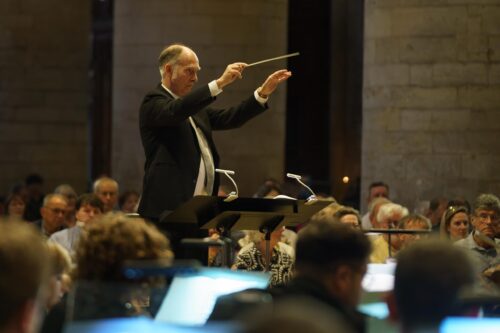
Adrian Partington established excellent tension right from the start in the orchestral introduction to ‘Der Spielmann’. This set the tone for everything that was to follow. Partington brought out the colour and drama in the music; I had a good view of the rostrum and it was evident that he had the score at his fingertips and was guiding all the performers urgently and clearly through music that is not exactly standard concert fare. The orchestra responded acutely to his direction and even though there were inevitable problems of balance at times this was a price worth paying for the vitality of the performance. The chorus, too, were highly energised. They are particularly involved in ‘Hochzeitstücke’ and here they sang with palpable commitment and assurance; clearly, they had been well schooled in this music which, for most amateur choral singers, is not only unfamiliar but also at times very unconventional for its time. I thought they did very well.
Mahler used three soloists. I am afraid soprano Lee Bissett was a serious disappointment. I formed the impression, perhaps wrongly, that she wasn’t entirely at ease with the music. It sounded to me as if she was trying too hard to project; as a result, both diction and, on occasion it seemed, intonation, suffered. Her significant lamenting solo (‘Ach Bruder. lieber Bruder mein’) should be a high point of the work but Bissett’s singing was insufficiently controlled, as was her final cry of ‘Ach Leide!’ just before the end of the cantata. More positively, Elgan Llyr Thomas carried on in the same vein as in the Bruckner. The tenor role is less prominent in Das klagende Lied but everything that Thomas did was accurate, involving and highly committed. The alto part in the Bruckner Te Deum doesn’t give the soloist much opportunity to shine but, by contrast, Mahler entrusts a great deal of the narrative to his alto soloist. Claudia Huckle rose to the occasion splendidly. Her singing per se, was excellent; her voice was ideally focused and her diction was very clear. I recall that it was a mantra of the distinguished tenor John Mitchinson that the primary responsibility of a singer is to ‘tell the story’. No one listening to Huckle tonight would have been disappointed in her narrative engagement. Not only did she tell the story most expressively with her voice but also there was visible engagement with the audience. True, there were a few occasions when she sang in her lowest register and was rather overpowered by the orchestra, but I am in no doubt that in these instances the ‘fault’ lay with Mahler’s inexperience as an orchestrator. Overall, I was very impressed with Huckle’s singing; she drew me in to the story and made it come alive.
Seeing Huckle deliver the narrative was just one aspect of this performance that reminded me that experiencing a live performance offers so much more than listening to a CD. Another equally important moment came in ‘Hochzeitstücke’. The first two stanzas of poetry describe the wedding festivities; Mahler sets all this to exuberant music. Then the minstrel arrives to spoil the party and Mahler changes the mood abruptly; his arrival, and the effect his presence has on the king, are illustrated by chilling orchestral sounds, not least from muted horns. This mood change came out more potently than I can ever recall hearing. Partington and the British Sinfonietta did full justice to Mahler’s originality as an orchestrator. Hitherto, I have heard Das klagende Lied in recorded performances which have used the offstage band in ‘Hochzeitstücke’. Hearing the material played by the onstage orchestra was an interesting experience. It was perfectly satisfactory, though Mahler’s more daring spatial effects, though extravagant, undeniably add an extra dimension. However, with everyone watching concert budgets these days, I see no reason why the version performed tonight could not be a perfectly valid alternative, especially if it encourages more performances of the work.
It has taken me some six decades to experience a live account of Das klagende Lied but it was worth the wait. This was a vivid, dramatic and memorable performance which I enjoyed very much
The Cheltenham Music Festival runs until 11 July. Full details are here
John Quinn
Featured Image: Soloists, South Cotswold Big Sing Group, British Sinfonietta and Adrian Partington (conductor) © Michael Whitefoot